
How to Structure Content So AI Search Engines Can Cite You
If you want ChatGPT, Perplexity, or Google’s AI search experiences to surface and cite your content, good writing alone is not enough. Your content also needs to be easy to understand, verify, and extract.
I started paying much closer attention to this while reviewing client content and SEO audits this year. Across dozens of pages, I kept seeing a similar pattern: the strongest information was often buried inside long introductions, vague headings, or paragraphs that mixed several different claims together.
That matters more as search becomes increasingly answer-driven.
AI search systems do not simply return a list of ten blue links. They can search across the web, identify relevant sources, synthesize information, and present an answer with links or citations to the underlying sources. Perplexity explicitly describes this process, while OpenAI says public websites can be surfaced and clearly cited in ChatGPT Search.
The goal, then, is not to “write for AI” instead of humans.
The goal is to make your content clear enough for both.
The short version
If you want your content to be easier for AI search systems to understand and potentially cite:
- Put the direct answer close to the question being answered.
- Use descriptive headings instead of vague or overly clever ones.
- Keep each section focused on one clear sub-question or claim.
- Use tables, lists, definitions, and other structured formats when they genuinely improve clarity.
- Support important claims with original data or trustworthy sources.
- Make it obvious who wrote the content and why they are qualified to discuss the subject.
- Keep important facts current when they can change over time.
- Make your website accessible to the crawlers used by the search systems you want to appear in.
There is no guaranteed “AI-citation formula.” Search systems do not publish a rule saying that a page will be cited because it uses a particular number of words, headings, or FAQ sections.
What we can do is make the information easier to interpret, verify, and use.
What does “AI-citable” actually mean?
I use “AI-citable” as a practical description, not as an official ranking factor.
A piece of content is easier to cite when an AI system can identify a specific claim, fact, definition, comparison, or explanation and understand what it means without needing to reconstruct the argument from several disconnected paragraphs.
For example, compare these two approaches.
Less clear:
There are many different factors that can influence how quickly SEO produces results, and every website is different, so it is difficult to provide an exact timeline…
More direct:
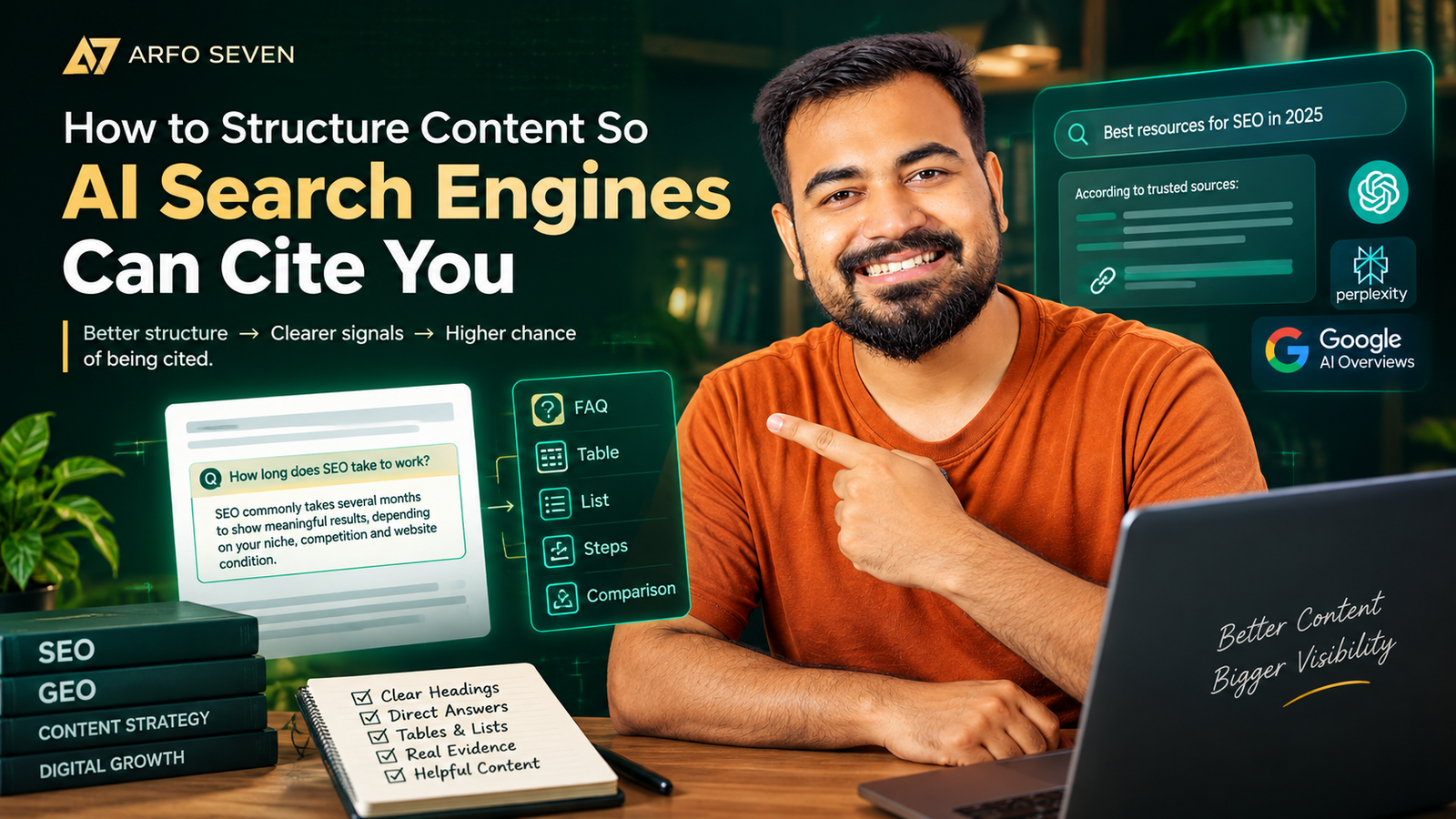
SEO commonly takes several months to produce meaningful results, although the timeline varies by competition, website condition, content quality, authority, and search demand.
The second version gives the reader an answer immediately. The explanation can come afterward.
That does not mean the second sentence is automatically more likely to be cited. It simply gives a search system a much cleaner information unit to interpret.
That distinction is important.
Why this matters more in AI search
Traditional search often asks users to choose a result from a page of links.
AI search increasingly tries to answer the question itself.
Perplexity, for example, describes its system as searching the web, identifying relevant sources, and synthesizing them into a conversational answer with citations to original sources.
ChatGPT Search similarly uses web search to provide current information and relevant source links, and OpenAI now provides specific guidance for publishers who want their websites to be discoverable, surfaced, and cited.
That creates a different visibility opportunity.
You are no longer competing only for a traditional search-result position.
You are also trying to become one of the sources an answer engine considers useful enough to reference.
Does AI search reduce website clicks?
Sometimes, yes.
But the picture is more complicated than “AI search kills organic traffic.”
A 2025 Pew Research Center analysis examined 68,879 Google searches from browsing data collected from 900 U.S. adults. Around 18% of the searches in the study produced an AI-generated summary.
When an AI summary appeared, users clicked a traditional search result in 8% of visits, compared with 15% when no AI summary appeared. Clicks directly on links cited inside the AI summaries occurred in only 1% of visits to pages with an AI summary.
That is a significant reason to care about being visible inside the answer.
But it does not mean clicks disappear completely.
Google has reported that AI features are generating more searches and that, according to its own data, organic click volume overall has remained relatively stable year over year, while the company says the quality of some clicks has increased.
The practical takeaway is not “forget SEO.”
It is:
Build content that can win visibility in both traditional search and AI-generated answers.
How should you structure your headings?
Use headings that clearly describe the question or subject being answered.
For example:
Weak:
The SEO Timeline Explained
Clearer:
How Long Does SEO Take to Work?
The second heading immediately tells both the reader and the search system what the following section is about.
There is some useful evidence behind the broader idea of question-driven search.
Pew’s analysis found that Google searches beginning with question words such as “who,” “what,” “when,” or “why” were more likely to produce AI summaries. Sixty percent of searches beginning with those question words produced an AI summary in its dataset.
That does not prove that converting every heading into a question will increase citations.
It does show that question-based search behavior is strongly connected with AI-generated search experiences.
So use question headings where they naturally match the information your audience is looking for.
Do not turn every heading into a question simply because you heard that “GEO likes questions.”
Keep your heading hierarchy logical
Your headings should explain the relationship between ideas.
For example:
H2: How Long Does SEO Take to Work?
H3: What affects the SEO timeline?
H3: How competitive is the industry?
H3: How quickly can a new website build authority?
Each H3 answers a sub-question related to the H2.
That structure helps readers navigate the article and gives search systems clearer contextual boundaries.
The important point is not the H2/H3 labels themselves.
It is the logical relationship between sections.
Put the direct answer before the long explanation
One of the most useful writing habits I have adopted is simple:
Answer first. Explain second.
If someone asks:
How often should you update evergreen content?
Do not make them read five paragraphs before discovering your recommendation.
Start with the answer:
Evergreen content should be reviewed regularly and updated whenever important facts, statistics, prices, regulations, products, or recommendations change. A fixed three-month or six-month schedule can be useful as a review process, but freshness should depend on how quickly the information itself changes.
Then explain the reasoning.
This approach is better for humans because readers can immediately understand the answer.
It is also easier for an answer system to interpret because the central claim is clearly separated from the supporting discussion.
I would not, however, claim that a specific 40–80 word “answer block” is a proven citation requirement. I have not found sufficiently strong independent evidence to support that as a universal rule.
Use tables when comparison is actually involved
Tables can be extremely useful when the reader needs to compare structured information.
For example:
| Content format | Useful for |
| Comparison table | Features, products, options, differences |
| Numbered list | Processes and step-by-step instructions |
| Bullet list | Key points and summaries |
| FAQ | Direct questions and concise answers |
| Narrative paragraphs | Context, examples, analysis and storytelling |
A table gives each piece of information a defined position.
That can make complicated comparisons easier for both readers and machines to interpret.
But do not create tables simply to make an article “AI-friendly.”
If a table does not improve understanding, it is probably unnecessary.
Make claims easy to verify
This is where many GEO articles become weak.
They talk about “AI citation optimization” but provide very little evidence for their own recommendations.
If you claim:
AI search users rarely click cited sources.
You should be able to point to research.
Pew’s 2025 analysis found that only 1% of visits to Google results pages containing an AI summary resulted in a click on a source link inside that summary.
That is much stronger than simply repeating a claim because other SEO blogs are repeating it.
The same principle applies to your own data.
If you have:
- 74 audits
- 18 completed projects
- $45,000 in project revenue
say that clearly.
But distinguish your experience from external research.
Your audit data is your evidence.
Pew’s dataset is independent evidence.
They should not be presented as if they are the same thing.
Original data can make content more valuable
One of the strongest ways to differentiate an SEO article is to publish information that other pages do not have.
That could be:
- Your own audit findings
- A dataset from your clients
- Before-and-after measurements
- Controlled experiments
- Search-result observations
- Survey results
- Original screenshots
- Pricing comparisons
- Industry observations collected over time
For example:
We reviewed 74 client audits in 2026 and found that…
That is much more interesting than another article saying:
“Experts believe structured content is important for GEO.”
But there is an important rule:
Do not turn a small personal dataset into a universal industry statistic.
If your 74 audits produced an observation, call it an observation.
Do not automatically call it a “GEO ranking factor.”
Who wrote the content matters
AI search systems are increasingly designed around source quality and verifiability.
Perplexity, for example, says its source-review process can label domains as Government, Academic, or Trusted, and its review process considers factors including whether a website identifies who wrote its content and whether it corrects mistakes.
That has an important implication for publishers:
Do not hide the author.
A strong article should make it easy to understand:
- Who wrote it
- What the author’s experience is
- When it was published
- When it was updated
- What sources were used
- Which statements are original observations
- Which claims come from external research
This is useful for human readers even if an AI system never cites the page.
Make your website accessible to AI crawlers
Content quality does not help much if the relevant search system cannot access the page.
OpenAI’s publisher guidance specifically says public websites can appear in ChatGPT Search and recommends allowing OAI-SearchBot to access site content if you want that content to be included in ChatGPT summaries and snippets.
This is not a substitute for good SEO.
You still need a technically accessible website, indexable pages, useful content, and appropriate internal linking.
Think of crawler access as the entrance to the building.
It does not guarantee that anyone will choose your room.
What about schema markup?
Schema can help search engines understand what a page contains.
But I would avoid making the claim that schema markup is a requirement for AI citation.
The more defensible position is:
Use structured data when it accurately describes your content and is supported by the search engine’s documentation.
Do not add FAQ or HowTo markup simply because someone says it is a GEO shortcut.
Likewise, do not assume that adding schema automatically makes an AI system cite your page.
There is no reliable evidence that a particular schema type guarantees citation.
Should every article have an FAQ section?
No.
Use an FAQ when people genuinely have related questions that deserve separate answers.
A useful FAQ might look like this:
Does GEO replace SEO?
No. GEO and traditional SEO overlap but are not identical concepts. Technical accessibility, indexing, content quality, links, and other established SEO fundamentals still matter. AI search adds another layer in which systems retrieve and synthesize information from sources.
Do I need schema markup to be cited by AI search engines?
No universal rule says that schema markup is required for AI citation. Structured data can help search engines understand supported content types, but it should accurately represent the page and should not be treated as a guaranteed citation mechanism.
How long does it take for changes to appear in AI search?
There is no universal timeline. A page may need to be crawled and reprocessed before changes become available to a search system, and different systems have different retrieval and indexing processes.
What does this actually look like in practice?
We ran 74 audits through this framework in 2026.
Eighteen turned into finished, delivered projects. The remaining opportunities disappeared for different reasons, including budget changes, project-fit issues, and clients who needed a longer runway than they were prepared to commit to.
The 18 completed projects generally ran between three and six months. The longer timelines tended to involve more competitive niches where meaningful structural and content improvements required more than simply waiting for rankings to move.
Altogether, those projects generated $45,000 in revenue.
That is our experience, not an industry benchmark.
One particularly memorable complication happened during the middle of a project cycle.
A few of us took a short trip to Cox’s Bazar. During the trip, a laptop went missing. With help from the local police, we eventually recovered it, but the incident added roughly a week to the trip.
During that period, we were effectively unreachable.
Several clients had already paid and were waiting for responses. Three understandably assumed something had gone seriously wrong.
When we returned, we caught up with everyone. All three stayed, and each eventually became one of our steadier client relationships.
It was not a comfortable experience.
But it taught me something that has nothing to do with algorithms:
Trust is easier to recover when the underlying work is actually worth trusting.
That is also how I think about AI search visibility.
You can optimize the structure of a page all you want.
If the information underneath it is weak, unsupported, outdated, or indistinguishable from hundreds of other articles, better formatting will not magically turn it into a valuable source.
The real goal of GEO is not “writing for AI”
This is probably the biggest distinction I would make.
Do not create content that sounds robotic because you are trying to make it “machine-readable.”
Create content that is:
- Clear
- Specific
- Well structured
- Evidence-backed
- Original
- Easy to verify
- Written by someone with relevant experience
- Useful even when the reader never sees an AI-generated answer
Then structure that information so an AI system can understand the individual claims.
That is a much more sustainable approach than chasing a supposed “GEO hack.”
Final takeaway
AI search is changing how people discover information.
Google’s AI features can generate summaries with links to sources. ChatGPT Search can surface and cite public websites. Perplexity searches the web and provides citations to sources.
At the same time, independent research shows that when Google’s AI summaries appear, users can be less likely to click traditional results—and direct clicks on cited sources are relatively rare.
That makes source visibility increasingly important.
But there is no magic heading formula, no guaranteed word count, and no single schema trick that guarantees an AI citation.
The better strategy is simpler:
Answer the question clearly. Support the answer with evidence. Show your expertise. Structure the information logically. Make the page accessible. And give the search system a source worth citing.
That is not just GEO.
That is good content.