
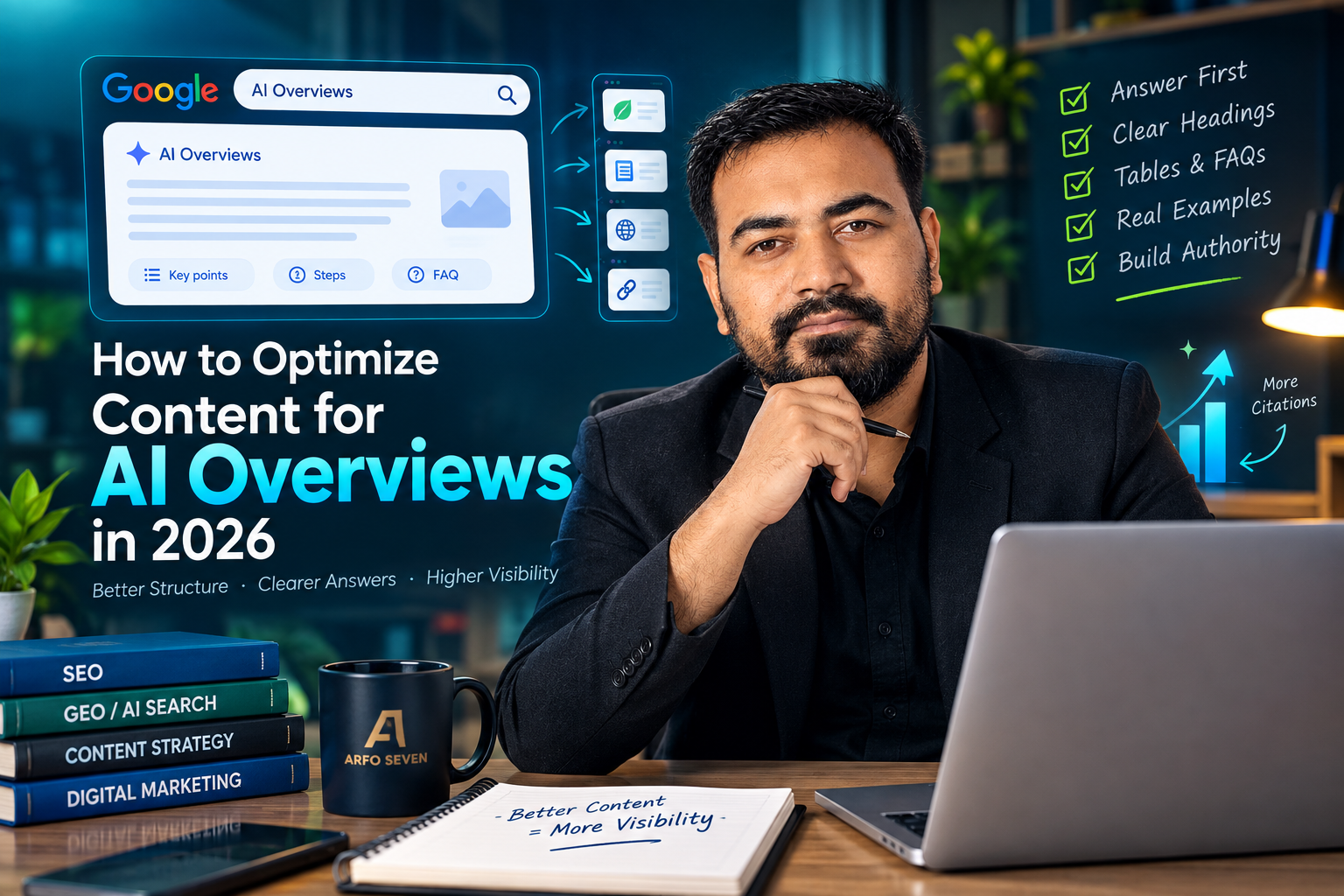
Google Search has changed. A page no longer has to compete only for a blue-link position; it may also need to become a source that Google’s AI systems can understand, evaluate, and cite.
But there is a common mistake in how people approach AI Overview optimization: they assume that adding more FAQs, shorter paragraphs, or a few question-based headings is enough.
It isn’t.
The stronger approach is to create content that does three things at the same time: answers the searcher’s question clearly, demonstrates first-hand or credible expertise, and gives search systems enough context to understand where each claim comes from.
That distinction matters because recent research shows that AI Overview citations do not simply mirror Google’s traditional top 10 results.
In a 2026 Ahrefs analysis of 863,000 keyword SERPs and roughly 4 million AI Overview URLs, only 37.9% of cited URLs also appeared within the first 10 search-result blocks. A substantial share appeared between positions 11–100 or even outside the top 100.
So the real question is no longer:
“How do I rank in the top 10?”
It is:
“How do I become one of the most useful sources Google can use when constructing an answer?”
That is the problem this guide addresses.
Key Insights
- Traditional Google rankings still matter, but they do not completely determine AI Overview citations.
- AI Overview systems can draw from pages outside the traditional top 10.
- Clear answer-first writing makes information easier for both users and machines to understand.
- Tables, lists, definitions, examples, and FAQs can make complex information easier to retrieve—but they are formats, not ranking tricks.
- Original information, first-hand experience, evidence, and useful analysis are increasingly important.
- There is no reliable “40–60 word rule” that guarantees an AI Overview citation.
- Word count alone is not an optimization strategy. Research from Ahrefs found almost no correlation between content length and AI Overview citation.
- Google continues to emphasize normal SEO fundamentals alongside optimization for its generative AI search features.
What Are Google AI Overviews and Why Are They Different From Traditional Search?
Google AI Overviews are generated responses that appear within Google Search and summarize information from multiple sources.
Traditional SEO asks a relatively straightforward question:
Which page should rank for this query?
AI search introduces another layer:
Which sources can help construct a useful answer to this query?
That difference changes how we should think about content.
A page ranking third can be cited. A page ranking outside the top 10 can sometimes be cited. And a page that performs well for one query may not necessarily be selected for a closely related AI-generated question.
This is not just theory.
Ahrefs’ 2025 study of 1.9 million AI Overview citations found that 76.1% of cited pages ranked within Google’s top 10 at that time. But its March 2026 update, using a much larger dataset, found only 37.9% of cited URLs also appeared within the first 10 SERP blocks.
The numbers changed dramatically.
The lesson is not that rankings no longer matter.
The lesson is that AI visibility cannot be reduced to traditional ranking position.
Traditional SEO Ranking vs. AI Overview Visibility
Traditional SEO still depends on many established signals: relevance, quality, links, site reputation, technical accessibility, and satisfying search intent.
AI-generated search adds another challenge.
The system needs to identify useful information from potentially different sources and combine it into a response.
That means a paragraph containing a precise answer can be valuable even when the page as a whole is not the highest-ranking result.
But there is an important correction to make here.
It would be misleading to say that AI Overviews simply “ignore authority and backlinks.”
They don’t.
Google’s own guidance continues to emphasize the importance of established SEO practices for appearing in its generative AI search experiences.
Our view at ARFO SEVEN is therefore simple: don’t replace SEO with GEO. Build strong SEO first, then make the information easier to understand, verify, extract, and reuse.
How Should You Structure Content for AI Overviews?
Start with the answer instead of making the reader work for it.
If the page is answering:
“How do I optimize content for AI Overviews?”
the first paragraph should answer that question immediately.
Don’t spend the first 150 words telling readers why AI is changing the internet.
Tell them what to do.
Then explain the reasoning.
A useful structure is:
- Direct answer
- Key takeaways
- Supporting explanation
- Evidence or examples
- Practical steps
- Comparison or table where appropriate
- FAQs for genuinely unanswered questions
- Sources or references where claims need verification
This structure works because it serves two audiences simultaneously: people who want a fast answer and readers who want to understand the subject deeply.
Write an Answer-First Opening
Consider the difference.
Weak opening
AI is changing the digital marketing landscape at an unprecedented pace. With the rapid development of artificial intelligence, marketers need to rethink how they create content…
This sounds polished, but the reader still doesn’t know what to do.
Stronger opening
To optimize content for AI Overviews, make the answer easy to identify, support important claims with reliable evidence, demonstrate genuine expertise, and organize related information into clearly defined sections. Traditional SEO still matters, but AI visibility requires more than ranking for one keyword.
The second version wastes less time.
More importantly, the reader immediately understands the point of the article.
Do 40–60 Word Answer Blocks Guarantee AI Overview Citations?
No.
This is one of the areas where SEO advice can easily turn into a formula that sounds scientific but isn’t.
A previous version of this article suggested that 40–60 word answer blocks were more likely to be quoted. Without a reliable source demonstrating that specific threshold, that claim is too strong.
There is no publicly documented Google rule saying:
“Write exactly 40–60 words and you will increase your chance of appearing in AI Overviews.”
The better principle is:
Make each important answer self-contained enough that a reader can understand it without reconstructing the meaning from five surrounding paragraphs.
That may take 35 words.
It may take 80.
It may take 150.
The subject should determine the length—not an arbitrary formula.
This is consistent with broader research showing that content length itself is not a strong predictor of AI Overview citation. Ahrefs analyzed more than 174,000 pages and found a near-zero correlation between word count and citation likelihood.
Should You Use Question-Based Headings?
Yes—but don’t turn every heading into a question just because an SEO template told you to.
A question heading is useful when it reflects a real information need.
For example:
How Does AI Overview Selection Differ From Traditional Rankings?
is useful because it describes exactly what the section answers.
But:
What Is a Table?
would add little value to an experienced reader.
The principle is simple:
Use headings to make the information architecture obvious.
If a reader can scan only the headings and still understand the argument of your article, your structure is probably working.
What Content Formats Help AI Systems Understand Information?
There is no single “AI Overview format.”
Different questions naturally require different structures.
Use a table when the reader is comparing things
For example:
| Question | Best format |
| Which SEO tool is better? | Comparison table |
| What are the steps? | Numbered list |
| What does a term mean? | Definition + explanation |
| How do I solve a problem? | Step-by-step process |
| What mistakes should I avoid? | Bulleted list |
| What questions remain? | FAQ |
The important point is that the format should follow the information.
Don’t add a table simply because someone says tables are “AI-friendly.”
Where Tables Are Better Than Paragraphs
Tables are particularly useful when the same criteria apply to multiple items.
Imagine comparing three SEO strategies across:
- Cost
- Implementation time
- Difficulty
- Best use case
- Main limitation
Writing all of that in prose forces the reader to mentally construct the comparison.
A table does the opposite.
It exposes the relationships immediately.
That’s useful for humans and machines.
But a table should contain real information—not five vague marketing sentences squeezed into cells.
Where FAQs Actually Help
FAQs are useful when readers genuinely have additional questions that don’t fit naturally into the main narrative.
For example:
Can a page outside Google’s top 10 appear in an AI Overview?
That’s a legitimate question.
And current research suggests the answer is yes.
Ahrefs’ 2026 analysis found that 31.2% of cited URLs ranked between positions 11–100, while another 31.0% were outside the top 100 blocks in one of its measurements.
That is a much stronger FAQ answer than simply saying:
“Yes, AI Overviews can cite lower-ranking pages.”
The evidence gives the answer weight.
What Matters More: Keywords or Semantic Coverage?
Keyword density is not a useful target for modern content creation.
Instead of asking:
“How many times should I use my keyword?”
ask:
“What information would someone expect to find on a genuinely useful page about this topic?”
For an article about AI Overview optimization, that might include:
- Google AI Overviews
- AI search
- generative AI
- citations
- search intent
- traditional SEO
- content quality
- first-hand experience
- structured information
- sources
- examples
- entities
- technical accessibility
- search visibility
These concepts create topical completeness.
But there is another important distinction:
Semantic coverage is not the same as stuffing related keywords into a page.
A page can mention 50 related terms and still provide no original value.
Why Original Experience Matters More Than Another Generic Explanation
This is where many AI-generated SEO articles become interchangeable.
Imagine ten agencies publishing articles about:
“How to Optimize Content for AI Overviews.”
If all ten articles say:
Answer questions directly.
Use clear headings.
Add FAQs.
Use tables.
Write concise paragraphs.
the reader has no reason to remember one agency over another.
Now imagine one agency publishes:
“We tested the same topic across 12 pages and found that the pages with the clearest definitions weren’t necessarily the ones receiving citations. The strongest difference came from pages containing original examples and information that wasn’t repeated across competing pages.”
That is interesting.
It creates a reason to believe the author has actually observed something.
But there is a rule: never invent the experiment.
If ARFO SEVEN has not actually conducted that 12-page test, don’t publish it.
Instead, publish your real observations from real projects.
That is how you turn AI-assisted content into expert content.
What Counts as Original Information?
Original information doesn’t always mean conducting a scientific study.
It can be:
- A real client observation
- A before-and-after example
- A process your agency developed
- A failed experiment
- A screenshot from a real campaign
- A real ranking change
- A content audit pattern
- A technical implementation detail
- A calculation based on your own dataset
- A documented workflow
- An opinion developed from repeated professional experience
For example:
“When we review a service page, we don’t start by asking whether the keyword appears enough times. We first ask whether the page answers the customer’s five most important questions without forcing them to open another page.”
That’s an expert process, not generic AI filler.
Does Ranking in Google’s Top 10 Still Matter?
Absolutely.
But the relationship between rankings and AI citations is more complicated than it used to be.
Ahrefs’ 2025 study found that 76.1% of AI Overview citations came from pages ranking in the top 10.
Then its 2026 update found that only 37.9% of cited URLs also appeared in the first 10 SERP blocks for the same query.
Why did the number change?
One likely factor is Google’s use of query fan-out—breaking a complex search into related subqueries and retrieving information from a broader set of results.
That means a page may not rank highly for the exact wording of the user’s original query but can still be relevant to one of the underlying questions used to construct the answer.
This changes how content strategy should work.
Instead of creating one page around one keyword, think about the information ecosystem surrounding the topic.
A Practical Example: One Keyword vs. One Topic
Suppose the target topic is:
“How to choose an SEO agency.”
A keyword-focused article might repeatedly target:
best SEO agency
SEO agency
SEO company
SEO services
A topic-focused article would answer:
- How much does SEO cost?
- What should an SEO agency actually deliver?
- How long should SEO take?
- What reporting should clients receive?
- How can you identify fake SEO guarantees?
- What should be included in a technical SEO audit?
- How do you evaluate previous results?
- Should you hire a freelancer, agency, or consultant?
- What questions should you ask before signing a contract?
The second article gives search systems a much richer representation of the subject.
More importantly, it gives a human buyer a reason to trust the page.
What About Schema Markup?
Schema markup can help search engines understand the meaning and structure of content.
But it should not be presented as a secret method for getting into AI Overviews.
Google’s documentation does not say that adding FAQPage or HowTo schema guarantees AI Overview inclusion.
And there is an important 2026 development here: Google deprecated the FAQ rich-result feature for normal search results in May 2026.
That doesn’t mean structured data has become useless.
It means SEOs should stop treating every schema type as a guaranteed visibility feature.
Use structured data when it accurately represents the content and is supported by Google’s current documentation.
Don’t add markup simply because an AI-search checklist says you should.
How Should You Approach Multilingual Content?
Multilingual websites have an additional challenge: translation quality.
A technically correct translation can still sound unnatural.
For example, an English sentence with several qualifications may become an even longer sentence after translation.
That creates problems for readers before it creates problems for search engines.
The solution is not to “write for AI.”
The solution is to write naturally for the target language.
After translation, review:
- Sentence length
- Terminology
- Local search intent
- Cultural context
- Examples
- Units and currencies
- Local entities
- Search vocabulary
- Reading level
A Bangladeshi reader searching for a local SEO service should not receive an article that sounds like it was translated from a US corporate brochure.
Localization is more than translation.
How We Would Build an AI-Ready Content Brief at ARFO SEVEN
Our preferred approach is not to give a writer a keyword and ask for 2,000 words.
A stronger brief answers five questions first:
1. What is the searcher’s actual problem?
Not the keyword.
The problem behind the keyword.
2. What must the reader understand immediately?
This becomes the answer-first section.
3. What evidence can support the important claims?
Research, original data, documentation, case studies, screenshots, experiments, or first-hand observations.
4. What questions naturally follow?
These become supporting sections or FAQs.
5. What can we add that competing pages don’t have?
This is the most important question.
Because if your article contains exactly the same information as the other 20 pages ranking for the topic, simply reorganizing that information does not automatically make it authoritative.
The Difference Between AI-Assisted Content and AI-Dependent Content
Using AI to help research, organize, edit, or improve content is not the same as publishing generic AI output.
The difference is the human contribution.
AI-dependent content
- Generic claims
- Generic examples
- No evidence
- No original observation
- Repetitive structure
- Empty authority statements
- Same advice found everywhere
AI-assisted expert content
- Human-defined angle
- Real experience
- Original examples
- Verified research
- Clear opinions
- Real data
- Human editing
- Specific recommendations
- Transparent limitations
AI can help produce the first draft.
It should not be responsible for inventing the expertise.
FAQ
Do I need to rewrite my entire website for AI Overviews?
No.
Start with pages that already have meaningful organic visibility, traffic, commercial intent, or strategic importance.
Improve the answer to the main query, strengthen evidence, remove unnecessary repetition, improve information architecture, and add genuinely useful information.
A complete rewrite is not automatically better than a targeted improvement.
Can a page outside Google’s top 10 appear in an AI Overview?
Yes.
Current research shows that AI Overview citations can come from pages ranking beyond the traditional top 10—and in some cases from pages outside the top 100.
However, this should not be interpreted as “rankings don’t matter.”
Traditional search visibility remains an important part of the ecosystem.
Is there a perfect word count for AI Overview optimization?
No.
Research from Ahrefs found a near-zero correlation between word count and AI Overview citation. Its analysis found cited pages ranging from short articles to long-form resources.
Write enough to answer the question properly.
Stop when the useful information stops.
Should every H2 be written as a question?
No.
Use question-based headings when they make the reader’s intent clearer.
Use descriptive headings when they communicate the structure better.
The goal is clarity—not turning an article into a list of questions.
Do tables improve AI Overview visibility?
Tables can make comparative information easier to understand and extract, but there is no reliable Google rule saying that adding a table guarantees AI Overview inclusion.
Use tables when the information is genuinely comparative.
Don’t manufacture tables just to satisfy an AI-content checklist.
Do I need FAQ schema to appear in AI Overviews?
No guaranteed schema shortcut exists.
Google deprecated FAQ rich results for normal Search in May 2026, so treating FAQ schema as a universal AI Overview tactic is outdated.
Use structured data when it accurately describes eligible content and follows Google’s current documentation.
Does keyword density matter for AI Overviews?
There is no useful keyword-density target to chase.
Use the language necessary to explain the topic naturally.
Cover important concepts, entities, questions, and relationships—but don’t turn semantic optimization into keyword stuffing.
Does AI-generated content automatically perform badly?
No.
The important distinction is between how content was produced and whether the final content is useful, accurate, original, and trustworthy.
The bigger risk is publishing generic material without meaningful human contribution.
Interestingly, Ahrefs found in one 2025 study that AI Overviews were actually more likely to cite pages their detector classified as AI-generated than human-written. That does not mean AI-generated content is inherently superior; it demonstrates why “AI detection” and “search usefulness” should not be treated as the same thing.
How quickly can a page appear in an AI Overview after optimization
There is no reliable fixed timeline.
Google needs to crawl and process the updated content, and AI Overview citations can change over time.
Recent third-party tracking also suggests substantial volatility in AI Overview citations, which is another reason not to judge a page based on a single search performed on a single day.
Track changes over time instead.
The Real Goal of AI Overview Optimization
The biggest mistake is thinking:
“How can I make Google quote my page?”
A better question is:
“If Google needs an answer to this question, why should my page be one of the sources it trusts?”
That question leads to better SEO decisions.
It forces you to look beyond keyword placement and ask:
- Is the answer actually useful?
- Is the information accurate?
- Is the source credible?
- Do we demonstrate first-hand experience?
- Do we have evidence?
- Have we added something competitors don’t have?
- Can a reader understand the answer quickly?
- Can the important claims be verified?
- Does the page satisfy the underlying search intent?
That’s where SEO and GEO begin to overlap.
Google’s own 2026 documentation continues to emphasize that the fundamentals of SEO remain relevant for generative AI search features. At the same time, Google’s newer guidance highlights the importance of providing information that isn’t simply commodity content repeated across the web.
So don’t build content around a checklist of AI tricks.
Build something worth citing.
The strongest AI-search strategy is still good content—but “good” now means more than well-written paragraphs. It means useful information, clear structure, evidence, expertise, and something original to contribute.
At ARFO SEVEN, that is the standard we would use when evaluating whether a page is genuinely ready for the next generation of search.